
Cherubini: Requiem / Marche funebre
 $25.00
Special Order
$25.00
Special Order3 - 6 weeks add to cart
LUIGI CHERUBINI
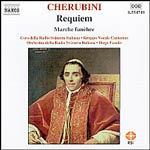
Cherubini: Requiem / Marche funebre
Orchestra della Svizzera Italiana, Gruppo Vocale Cantemus
[ Naxos / CD ]
Release Date: Thursday 12 December 2002
This item is only available to us via Special Order. We should be able to get it to you in 3 - 6 weeks from when you order it.
"How do they keep coming up with such people: relative unknowns who deliver sterling performances?"
"Naxos is amazing! How do they keep coming up with such people: relative unknowns who deliver sterling performances? The one thing I have in common with Beethoven is that this Requiem is one of my favorite pieces; I have heard almost every recording. This one may not be the best - I reserve that honor for Matthew Best on Hyperion, with the same coupling - but it is unique. I am not a religious man, but these singers convince me that they are true believers. Cherubini's music, here and in other works, has been criticized as being cold and distant; you would never guess that from this glowing performance. If it is less impassioned than, say, Muti on EMI, its soft human warmth is eye- and ear-opening, ravishing mind and heart. Nevertheless, there is plenty of power in the Dies Irae, if not the last word in precision. Some unusual balances, among instruments and between orchestra and chorus, are so revealing that they must be intentional. A few vocal difficulties with tricky rhythms, mainly in the Offertorium, keep this recording at arm's length from perfection. Naxos manages cathedral acoustics ideally, achieving a beautiful resonance while muffling few details. If price is important to you, I have no hesitation in recommending this disc; if not, I urge it on you as a second recording, whatever your first."
- Fanfare (James H North) January/February 2001
Luigi Cherubini was born in Florence in 1760, the tenth of the twelve children of the theatre harpsichordist at the Teatro della Pergola, his first teacher. As a child he had further instruction from leading Florentine composers and had an early composition, a Mass, performed in 1773, continuing in adolescence to write further church music and a smaller number of secular dramatic works. In 1778, after the performance of his cantata La pubblica felicità ('Public Happiness') in honour of the Grand Duke Leopold of Tuscany, he was awarded by the latter the means of further study with the well-known opera composer Giuseppe Sarti, a former pupil of Padre Martini. Cherubini's period with Sarti in Bologna and in Milan, where his teacher was maestro di cappella at the Cathedral and distinguished at the Teatro della Scala, brought the chance to compose operas for Florence and other Italian cities. In 1784 and 1785 he was in London, where he won success in the theatre, and from there he travelled to Paris. It was through the violinist and impresario Viotti, established in that city, that Cherubini was presented to Queen Marie Antoinette and in 1786 he settled in France, collaborating with Viotti under the patronage of the King's brother at the Théâtre de Monsieur at the Tuileries, before his great success with the opera Lodoïska at Viotti's new Théâtre Feydeau, a venture curtailed at the Revolution, when Viotti took refuge in London and the wine-trade.
After a period of retirement to the countryside, Cherubini returned to Paris in 1793, eventually finding employment as an inspector at the new Institut National de Musique, the future Conservatoire. The decade brought settings of texts approved by the new, secular régime and operatic success with what remains his best known opera, Médée ('Medea'), and with Les deux joumées ('The Two Days'), an opera that had its effect on Beethoven's own later Fidelio, the first performance of which Cherubini attended during a successful visit to Vienna in 1805. Napoleon's occupation of the city in that year and the unexpected favour he now showed to Cherubini, after earlier coldness, led the composer to return to Paris, where at first he found relief in activities other than music. The restoration of the monarchy after Napoleon's defeat brought him appointment in 1816 as a superintendent of the King's music under his former patron, now Louis XVIII. In these years Cherubini had begun to turn his attention once again to church music, notably with the Solemn Mass in C major and the Requiem in C minor of 1816. Further official honours followed, with significant appointment in 1822 as director of the Conservatoire, a position he held with distinction until a few weeks before his death in 1842.
Cherubini wrote his Requiem in C minor in 1815 and 1816 for a commemoration of the death of Louis XVI, executed by the revolutionaries, and it was first performed in the Crypt of Saint-Denis on 21st January 1816. The suggested revival of the work in 1834 at the death of Cherubini's former pupil, the composer Boieldieu, and the objection of the Archbishop of Paris to the use of women's and men's voices together in a liturgical performance led Cherubini to write a second Requiem in 1836, scored for men's voices and heard, as he had intended, at his own obsequies. The Requiem in C minor won high praise from Cherubini's contemporaries and successors, admired by Beethoven and by Berlioz, acclaimed by Schumann and by Brahms.
The opening motif of the Introit, heard from bassoons and cellos, sets the mood of solemn mourning and provides a unifying element for the Introit and Kyrie movement. Cherubini offers a setting of the Gradual as a G minor second movement, here scored for the four-part chorus with violas, cellos and double basses. The contrasting entry of the brass and the resonant sound of the gong herald the Dies irae, a dramatic evocation of the end of the world, with the sound of the last trump. Written as one movement, the traditional sequence allows its own changes of mood, as suggested by the text. The words Tuba mirum spargens sonum and Rex tremendae majestatis bring dynamic climaxes, offset by the gentler feeling of Salva me, fons pietatis, before the outburst of sound at the words Confutatis maledictis, the pleading of Voca me cum benedictis and the intensity of the final Largo, at the words
Lacrymosa dies ilIa. The Offertory is set in the key of E flat major, with an ethereal moment at the words Sed signifer sanctus Michael, as the Archangel leads the souls of the departed into eternal light. The movement follows tradition with a fugal setting of Quam olim Abrahae and here, as elsewhere, there seem memories of Mozart's great setting of the Requiem, a work that Cherubini himself had introduced to Paris in 1805. There is respite as prayers and sacrifice are offered, Hostias et preces tibi, Domine, laudis offerimus, a Larghetto, after which the vigorous Quam olim Abrahae promisisti returns. The A flat major Sanctus, couched in relatively conventional terms, is followed by a moving F minor setting of the Pie Jesu, words that had concluded the Dies irae. The whole work is crowned by the final Agnus Dei, in which the original key is restored, to end in a final C major as a concluding prayer is offered for all those whose memory is celebrated, the King himself and his family and many subjects who had died in the revolution.
Cherubini's Marche funèbre was written in 1820, the year of the assassination of the Duc de Berry, son of the future Charles X. It is one of a number of works written for the royal chapel and is scored for a large orchestra, without flutes, which Cherubini, in any case, disliked, but with a woodwind section that includes a double bassoon and a percussion section that makes use of a gong. This last is heard at the outset, before a roll of drums and the melancholy descending motif and ascending answering phrase. Gong and drums are used to punctuate the solemn march, as it proceeds.
Tracks:
Marche funebre
01. Marche funebre 07:23
Requiem for chorus and orchestra in C minor
02. Introitus et Kyrie: Requiem aeternam 07:14
03. Graduale: Requiem aeternam 01:33
04. Dies irae 10:26
05. Offertorium: Domine Jesu Christe 16:22
06. Sanctus 01:33
07. Pie Jesu 03:38
08. Agnus Dei 07:25
