
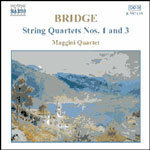
MARBECKS COLLECTABLE: Bridge: String Quartets Nos 1 & 3
 $30.00
Low Stock
add to cart
$30.00
Low Stock
add to cart
FRANK BRIDGE
MARBECKS COLLECTABLE: Bridge: String Quartets Nos 1 & 3
Maggini Quartet
[ Naxos / CD ]
Release Date: Friday 31 October 2003
This item is only available to us via Special Import.
"The flowering of English expressionism receives deservedly superb performances."
Gramophone Magazine (Editor's Choice. October 2003)
"Best known as Benjamin Britten's inspiring teacher and the source for Britten's superb Variations, Frank Bridge occupies a position in British music straddling the traditional worlds of the composition of his youth and the more radical 'Viennese' chromatic language of his later years. The 1906 First Quartet, Bologna (named after its success in a competition there) could almost be by an entirely different composer if put alongside the Third Quartet of 1926 - a powerful, radical work of genius."
Gramophone Magazine (Editor's Choice. October 2003)
Grammy Award Nomination 2005 - Best Chamber Music Performance
Frank Bridge studied the violin and composition at the Royal College of Music in London, where he was a pupil of Stanford from 1899 to 1903. Apart from composition, his career embraced performance as the viola player in several quartets, most notably the English String Quartet, conducting, in which he frequently deputised for Sir Henry Wood, and teaching, with Benjamin Britten his best-known pupil. Perhaps no other British composer of the first half of the century reveals such a stylistic journey in his music. His early works, such as the First String Quartet (1906), the Phantasy Piano Trio (1907) and the orchestral suite The Sea (1910-11), follow in the late-Romantic tradition bearing a kinship with Fauré; subsequently, in the orchestral tone poem Summer (1914), for instance, Bridge comes close to the orbit of Delius. After the First World War, however, his music became intense and chromatic as in the Scriabinesque Piano Sonata (1921-4). The radical language of the sonata was pursued in his chamber works of the 1920s, so that in the String Quartet No. 3 (1926) Bridge rubs shoulders with the early works of the Second Viennese School. Also to this decade belong two orchestral masterpieces, Enter Spring (1927) and Oration (1930). Finding little favour with public or critics, his late work, for example the Fourth String Quartet (1934-8), languished and despite Britten's advocacy, it was not until the 1970s that Bridge's remarkable legacy received the attention it deserved. - Andrew Burn
Tracks:
String Quartet No. 1 in E minor, "Bologna"
01. Adagio - Allegro appassionato 08:40
02. Adagio molto 09:27
03. Allegretto grazioso - Animato 04:47
04. Allegro agitato - Allegro moderato - Adagio molto 05:55
String Quartet No. 3
05. Andante moderato - Allegro moderato 11:52
06. Andante con moto 08:00
07. Allegro energico 10:38


