
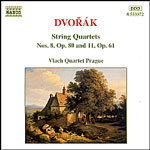
Dvorak-String Quartet No. 8 in E major, Op. 80; String Quartet No. 11 in C major, Op. 61
 $25.00
Out of Stock
$25.00
Out of Stock6+ weeks add to cart
Dvorak-String Quartet No. 8 in E major, Op. 80; String Quartet No. 11 in C major, Op. 61
Vlach Quartet Prague
[ Naxos / CD ]
Release Date: Thursday 11 November 2004
This item is currently out of stock. It may take 6 or more weeks to obtain from when you place your order as this is a specialist product.
"the new Vlach is quite wonderful, with enormous tonal panache, some soaring playing, and an old-fashioned Romantic approach which is just right for these middle-period Dvorak quartets"
- Fanfare
"The favourable impression created by the Vlach Quartet of Prague's first release in their Dvorak cycle for Naxos is further reinforced by this admirably recorded latest offering. Once again their achievement is considerable...an excellent buy."
- Gramophone - September 1996
"Naxos is doing remarkable well finding top-notch chamber ensembles ... now we have the excellent Vlach Quartet ... The performances are superb ... Keith Anderson's notes are fine, and the cover art is attractive. Another triumph for the budget-king."
- American Record - Guide Nov/Dec 1996
"the new Vlach is quite wonderful, with enormous tonal panache, some soaring playing, and an old-fashioned Romantic approach which is just right for these middle-period Dvorak quartets"
- Fanfare
Antonin Dvoøák was born in 1841, the son of a butcher and innkeeper in the village of Nelahozeves, near Kralupy in Bohemia and some forty miles north of Prague. It was natural that he should follow the example of his father and grandfather by learning the family trade, and to this end he left school at the age of eleven. There is no reliable record of his competence in butchery, but his musical abilities were early apparent, and in 1853 he was sent to lodge with an uncle in Zlonice, where he continued an apprenticeship started at home, learning German and improving his knowledge of music, rudimentary skill in which he had a1ready acquired at home and in the village band and church. Further study of German and of music at Kamenice, a town in northern Bohemia, led to his admission, in 1857, to the Prague Organ School, from which he graduated two years later.
In the years that followed, Dvoøák earned his living as a viola-player in a band under the direction of Karel Komzak which was to form the nucleus of the Provisional Theatre Orchestra, established in 1862. Four years later Smetana was appointed conductor of the opera-house, where his Czech operas The Brandenburgers in Bohemia and The Bartered Bride had a1ready been performed. It was not until 1871 that Dvoøák resigned from the theatre orchestra, to devote more time to composition, as his music began to draw some favourable local attention. Two years later he married and early in 1874 became organist of the church of St Adalbert. During this period he continued to support himself by private teaching, while busy on a series of compositions that gradually became known to a wider circle.
Tracks:
String Quartet No. 11 in C major, Op. 61
String Quartet No. 8 in E major, Op. 80
