
Falla: Amor Brujo (El) / El Sombrero de Tres Picos
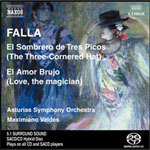 $27.00
Special Order
$27.00
Special Order3 - 6 weeks add to cart
MANUEL DE FALLA
Falla: Amor Brujo (El) / El Sombrero de Tres Picos
Maria Jose Martos (mezzo-soprano) / Alicia Nafe (mezzo-soprano) / Asturias Symphony Orchestra / Maximiano Valdes (conductor)
[ Naxos SACD / Hybrid SACD ]
Release Date: Thursday 23 June 2005
This item is only available to us via Special Order. We should be able to get it to you in 3 - 6 weeks from when you order it.
Manuel de Falla is generally acknowledged as the leading figure in Spanish music of the twentieth century. Born in 1876 in Cádiz, as a boy he aspired to be a writer but by the mid-1890s had decided to concentrate on music. - Hybrid/SACD in 5.1 surround sound. Playable on all compact disc players
Hybrid/SACD in 5.1 surround sound. Playable on all compact disc players
Manuel de Falla is generally acknowledged as the leading figure in Spanish music of the twentieth century. Born in 1876 in Cádiz, as a boy he aspired to be a writer but by the mid-1890s had decided to concentrate on music. To this end he studied in Madrid, his first works being for the piano. Between 1900 and 1904, to earn a living, he wrote six zarzuelas, the light operas popular in Spain. These were financially unrewarding but in Madrid he came under the influence of Felipe Pedrell (1841-1922), the great Catalan musicologist and composer. Pedrell inspired his students, among them Albéniz and Granados, to appreciate the historic traditions of Spanish music, with emphasis on folkmusic, and their relevance to contemporary composition.
In 1905 Falla won first prize with La vida breve (Life is Short) in a competition for Spanish opera awarded by the Royal Academy of Fine Arts of San Fernando, but as no public performance for the work was offered in Spain, he decided to seek better prospects in Paris. There he met various leading composers of the era, including Albéniz, Debussy, Dukas, Ravel, and Stravinsky. Several of his piano works and songs were performed, and La vida breve was eventually produced at the Casino Municipal in Nice in 1913, and repeated at the Opéra-Comique in Paris the following year.
At the outbreak of World War I Falla returned to Spain, where he was winning a reputation. La vida breve was performed on 14th November 1914 at the Teatro de la Zarzuela in Madrid, and Siete canciones populares españolas (Seven Spanish Folk-songs) a few weeks later, confirming his position as the foremost contemporary Spanish composer. In April 1915, at the Teatro Lara in Madrid, came the première of one of his finest masterpieces, the ballet with songs, El amor brujo (Love the Magician). This was followed by the first performance, in 1916, of Noches en los jardines de España (Nights in the Gardens of Spain), for piano and orchestra, and the success of another ballet, El sombrero de tres picos (The Three-Cornered Hat), first performed in Madrid in 1917.
In 1920 Falla moved to Granada. Here, with the poet, Federico García Lorca, he organized the famous Cante jondo flamenco competition of 1922, an attempt, regrettably not repeated, to conserve and revive the ancient art of Andalusian song. In Granada Falla composed El retablo de maese Pedro (Master Peter's Puppet Show), an adaptation of various episodes from Cervantes's Don Quixote, Psyché, the Concerto for harpsichord or pianoforte, Soneto a Córdoba (for voice and harp), and other works. His last completed composition was a set of four Homenajes (Homages) for orchestra, first performed in Buenos Aires in 1939, conducted by Falla himself. From 1927 until the end of his life, Falla worked on the cantata, Atlántida, a massively ambitious undertaking left unfinished but eventually completed by his eminent disciple, Ernesto Halffter (1905-1989), for its belated première in 1961.
Following the Spanish Civil War (1936-1939), and devastated by the tragic murder of his friend, Lorca, Falla left Spain in 1939 for Argentina. He died there in 1946 a few days before his seventieth birthday. He had suffered from severe ill health for many years, limiting his output. Yet, though not a prolific composer, his works are models of musical perfection in expressive content and technical mastery.
The one-act El amor brujo is the story of Candelas, a gypsy girl haunted by her dead lover, a ghost as jealous in death as he was in life. The attempts of her new suitor, Carmelo, to woo Candelas are frustrated by the ghost, so that they are unable to seal their love with the kiss which would rid them of this power from beyond the grave. The seductive Lucía is persuaded to act as a decoy and beguile the spirit with her charms.
The ballet begins with a brilliant Introduction and Scene 1 in which a dotted-note theme evokes the ghost's jealous nature. This contrasts with the nocturnal and sinister atmosphere of the gypsy's home of In the Cave 2, penetrated suddenly by a melody on the oboe in Andalusian style. The Song of a Broken Heart 3 is heard, a lament with dance rhythms reminiscent of flamenco cante jondo. After a few moments of swirling activity, The Apparition 4, gives way to Dance of Terror 5. The Magic Circle 6 offers momentary serenity as Candelas draws a magic circle on the ground and prepares to exorcize the ghost just as Midnight 7 sounds. The famous Ritual Fire Dance follows 8, driving away evil spirits with its percussive crossrhythms, vivid contrasts, and rich orchestral effects. The dance ends with hammer-like blows, as if victory over the disruptive force has been won. After an intermezzo designated as Scene 9, with quasi-improvisatory solos from the oboe and flute, it seems the ghost has not yet been exorcized. Song of the Will-o'-the-Wisp 10 tells that love is elusive. The haunting spirit is still potent as Pantomime 11 reiterates the ghost's theme from the Introduction, but the mood changes into a restrained tango in 7/8 time indicating that Lucía's charms are succeeding and the influence of the jealous spirit is fading. Dance of the Game of Love 12 completes the process, with words directed at the evil spirit: I am the voice of your destiny, I am the fire in which you burn, I am the wind in which you sigh, I am the sea in which you are shipwrecked. The music begins reticently but mounts to a climax as bells ring out and Candelas and Carmelo can at last embrace in uninterrupted bliss. The Finale, subtitled The Bells of Dawn 13, proclaims the return of happiness with a song and chiming of bells symbolic of daybreak and the triumph of love
