
Nielsen-Aladdin Suite / Pan and Syrinx / Helios Overture
 $30.00
Special Order
$30.00
Special Order3 - 6 weeks add to cart
NIELSEN
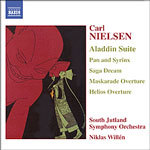
Nielsen-Aladdin Suite / Pan and Syrinx / Helios Overture
South Jutland Symphony Orchestra / Niklas Willen, conductor
[ Naxos / CD ]
Release Date: Tuesday 20 September 2005
This item is only available to us via Special Order. We should be able to get it to you in 3 - 6 weeks from when you order it.
EDITOR'S CHOICE GRAMOPHONE MAGAZINE (Awards Issue 2005)
"Take a bargain-priced route to Nielsen's realm and you won't be disappointed"
(Gramophone)
"Those curious about Nielsen but wanting for now to steer clear of the symphonies could hardly start in a better place. Nielsen fans need this disc even if they pass others by. As essential to the Nielsen collection as Chung's Bis symphonies (1, 2, 3, 5), Ole Schmidt's splendid symphony cycle on Regis, Bernstein's BMG-Sony recordings of numbers 3 and 5 and Ormandy of No. 6."
-- Rob Barnett, MusicWeb International, August 2005
Although he is most highly regarded for his six symphonies, Carl Nielsen also composed a number of short orchestral pieces whose musical preoccupations place them as satellites around those larger works. Aside from two operas he wrote prolifically for the theatre, as did his Finnish contemporary Sibelius, and various instrumental items from these scores have found an existence outside their original dramatic context.
Of the shorter orchestral works, the most famous is the overture Helios (FS32) which Nielsen wrote in 1904, the result of a journey to Greece with his wife, the sculptress Anne Marie Brodersen. The chief inspiration was the sun rising and setting over the Aegean Sea, and it is this image that opens and closes the piece. Over undulating strings, divided horns sound in evocative polyphony, while upper strings and woodwind outline a melodic idea of burnished richness. This rises to a serene climax for full orchestra, from which fanfaring trumpets initiate a striding theme which returns later in the piece. After this first appearance, a graceful idea for woodwind ensues; then, after a further brass entry, strings begin a lively fugato which draws the full orchestra into a reprise of the striding theme and its associated fanfare. From here the music subsides into its initial calm, solo horn and woodwind musing on the opening motifs as lower strings effect a return to darkness.
Composed during 1907 and 1908, the tone poem Saga-drøm (Saga-Dream, FS46) develops the idea of musical stasis in subtle and intriguing ways. At the opening, sombre yet serene strings evoke a mood of rapt contemplation, soon to be intensified by the addition of pensive brass and graceful woodwind arabesques. An animated motion now takes hold of the strings, over which brass continue as before; there ensues a piquant dialogue between pizzicato strings and woodwind, culminating in the magical passage where solo woodwind coalesce, over a held chord on double basses, in a cluster of unbarred exchanges, a notational feature which aroused much curiosity at the time. The strings and brass music heard earlier then returns to effect the briefest of climaxes, from which this attractive piece quickly withdraws beyond earshot, leaving as thoughtful yet elusive an impression as its title suggests.
Undoubtedly the finest of Nielsen's shorter orchestral pieces is the tone poem Pan and Syrinx (FS87), composed during 1917 and 1918, immediately after the Fourth Symphony and three years before he began work on the Fifth Symphony [both Naxos 8.550743], whose radical approach to timbre and texture is anticipated in several respects. At the outset rustling strings and undulating flute aptly evoke the pastoral nature of the Greek myth, combining gentleness and agitation to a telling degree. Percussion, notably xylophone and tambourine, enter as the musical expression quickly becomes more animated, subsiding to leave cor anglais and glockenspiel alone in thoughtful uncertainty. Timpani and strings gradually make their presence felt as the tension gradually accumulates, with untuned percussion taking on an obbligato rôle as a brief but raucous climax is reached. The opening music returns and, beneath a shimmering dissonance on violins, a solo cello tapers away into nothingness.
Tracks:
Aladdin Suite, Op. 34, FS 89
Cupid and the Poet (Amor og Digteren), Op. 54, FS 150 Helios Overture, Op. 17, FS 32
Maskarade, FS 39: Overture / Act II: Prelude
Pan and Syrinx (Pan og Syrinx), Op. 49, FS 87
Saga-Dream (Saga-drom), Op. 39, FS 46
