
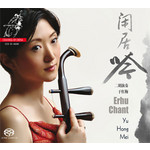
Erhu Chant
 $43.00
Special Order
$43.00
Special Order3 - 6 weeks add to cart
VARIOUS COMPOSERS
Erhu Chant
Yu Hong Mei (Erhu) with Liu Yin Xuan (Yang Qin) and Wu Lin (Chinese Harp)
[ Channel Classics SACD / SACD ]
Release Date: Monday 15 January 2007
This item is only available to us via Special Order. We should be able to get it to you in 3 - 6 weeks from when you order it.
The erhu is a Chinese fiddle known for its strong, yet melancholy sound. Internationally-acclaimed Chinese erhu player Yu Hongmei takes you on a remarkable journey through the versatile moods of this classical instrument.
SACD/hybrid pcm, stereo, multichannel
Playable on all compact disc players
Introduction to Music Recorded Idyllic Tune Idyllic Tune was composed in 1928 by Liu Tian Hua and the music was intended to portray a vivid picture of leisurely life. For the first time, the composer, who was familiar with idiomatic violin technique, made use of both unusual harmonies and numerous violinistic techniques. The music begins with an adagio melody, succeeded by a series of variations; the second section returns to an adagio gently tinged by sadness. Born in Jiang Ying of the Jiang Su province of China, Liu Tianhua (b 1895-d 1932) was one of the few pioneers of contemporary Chinese composers as well as one of the founders of Chinese instrumental music notation. He was also an Erhu performing artist and music teacher. After learning to play the violin and becoming acquainted with western musical theory, Liu Tian Hua employed his knowledge of western music for the continued evolution of traditional Chinese instrumental music. Weeping River of Sorrow Weeping River of Sorrow was written for the Guanzi, a type of woodwind instrument similar to the western recorder and oboe. The melancholy sound of the Guanzi is similar to that of the human voice. This composition was later arranged as a very popular Erhu solo piece. The music begins in the Erhu's low register, and then moves through a series of fourths, introducing a mournful theme suggestive of weeping and ultimately leading to an explosion of grief. The last section of the piece is extremely emotional. Celebrating the harvest of grapes Celebrating the harvest of grapes, composed by the well-known Erhu player Zhou Wei, is a very charming and interesting solo piece for Erhu. It depicts a scene of grape farmers picking and collecting grapes in Northwestern China, in the Xinjiag Province. The composer Zhou Wei was born in April 1961 in the eastern China province of Jiangsu. He entered the Shanghai Conservatory of Music in 1978, graduating in 1982, and was then employed as an Erhu soloist with the Eastern Song and Dance Troupe of China. Zhou Wei is known for his encyclopedic knowledge of Chinese music. In addition to being an instrumental soloist and instrument researcher, he is also a composer. Celebrating the harvest of grapes is just one of his many popular instrumental music works. Ode to Shanmenxia Gorge Ode to Shangmenxia Gorge was composed by Liu Jin Wen in 1960 when the composer was still a conservatory student. The piece consists of seven sections, each portraying a work scene at the Shanmenxia Gorge power plant building. 05 Birdsong echoing in a quiet valley (Erhu Solo) Inspired by a popular verse by Wang Wei, a well known Tang dynasty poet, composed in 1918 by Liu Tian Hua and edited in 1928, Birdsong echoing in a quiet valley vividly portrays a morning in a forest filled with songs of twittering birds, as described in Wang Wei's verse; the valley is deserted, and nothing but birdsong can be heard. The piece consists of five parts beginning with an introduction and ending with a coda. A Bunch of Flowers Originally written for the Suona (Chinese oboe) by Reng Tong Xiang in 1959 and later transcribed for Erhu, A Bunch of Flowers was compiled from some mournful folk songs and local opera tunes popular in the Shangdong province of east China. The music was intended to tell the story of poverty-stricken farmers as described in the novel Good Earth by Pearl Bucks. The music starts in sadness and ends in happiness, expressing the course of life as it moves from adversity to prosperity. Moon Reflected in the Twin-spring Lake (Er-quan-ying-yue) Moon Reflected in the Twin-spring Lake has enjoyed nation-wide popularity since its premiere by the composer, Hua Yan Jun (A-bing) in the 1930s. The history and significance of this piece have received numerous different interpretations. For example, it has been said that Hua Yan Jun (known by his nickname A-bing) was a wandering Erhu player who performed in the open air, and was always accompanied by his of his wife after he became blind. This work is a melancholy musical portrayal of the hard life of the composer as well as his persistent but disappointed hopes for a better future. Because of its great popularity, Moon Reflected in the Twin-Spring Lake has been transcribed for many different instrumental ensembles and orchestras. Ballad of North Henan Province Composed for Erhu in 1958 by Liu Wen Jin, a well known Erhu player and composer, this music was derived from music of the northern the Henan province. It takes the form of four movements with an introduction. The listener can hear various styles of playing, showing the many varieties of folk music which are popular in northern Henan. A 1961 graduate of the China Central Academy of Music, Mr. Liu Wen Jin is one of the leading composers of his generation. He has been the director of the China Central Ensemble of Chinese Traditional Instruments and President and artistic director of the China Opera House. Besides the above honours and positions, Mr. Liu Wen Jin was appointed guest professor at several prestigious conservatories and universities. Liu was also very famous for his three popular works written for Erhu; Ballad of North Henan Province, Shanmenxia Gorge Caprice, and Caprice Great Wall.
Tracks:
Idyllic Tune with harp
Weeping River of Sorrow with cymbalo
Celebrating the Harvest of Grapes with piano
Ode to Shanmenxia Gorge with piano
Birdsong echoing in a quiet valley Erhu solo
A Bunch of Flowers with cymbalo
Moon reflected in the Twin-spring Lake Erhu solo
Ballad
