
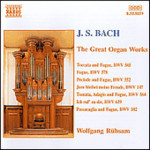
The Great Organ Works (Incls Toccata and Fugue in D minor)
 $25.00
Out of Stock
$25.00
Out of Stock6+ weeks add to cart
J.S. BACH
The Great Organ Works (Incls Toccata and Fugue in D minor)
Wolfgang Rubsam (organ)
[ Naxos Organ Encyclopedia / CD ]
This item is currently out of stock. It may take 6 or more weeks to obtain from when you place your order as this is a specialist product.
Johann Sebastian Bach was a member of a family that had for generations been occupied in music. His sons were to continue the tradition, providing the foundation of a new style of music that prevailed in the later part of the eighteenth century. Johann Sebastian Bach himself represented the end of an age, the culmination of the Baroque in a magnificent synthesis of Italian melodic invention, French rhythmic dance forms and German contrapuntal mastery.
Born in Eisenach in 1685, Bach was educated largely by his eldest brother, after the early death of his parents. At the age of eighteen he embarked on his career as a musician, serving first as a court musician at Weimar, before appointment as organist at Arnstadt. Four years later he moved to Mühlhausen as organist and the following year became organist and chamber musician to Duke Wilhelm Ernst of Weimar. Securing his release with difficulty, in 1717 he was appointed Kapellmeister to Prince Leopold of Anhalt-Cöthen and remained at Cöthen until l723, when he moved to Leipzig as Cantor at the School of St. Thomas, with responsibility for the music of the five principal city churches. Bach was to remain in Leipzig until his death in 1750.
As a craftsman obliged to fulfil the terms of his employment, Bach provided music suited to his various appointments. It was natural that his earlier work as an organist and something of an expert on the construction of organs, should result in music for that instrument. At Cöthen, where the Pietist leanings of the court made church music unnecessary, he provided a quantity of instrumental music for the court orchestra and its players. In Leipzig he began by composing series of cantatas for the church year, later turning his attention to instrumental music for the Collegium musicum of the University, and to the collection and ordering of his own compositions.
Tracks:
Toccata and Fugue in D minor, BWV 565
Fugue in G minor, BWV 578
Prelude and Fugue in E flat major, BWV 552 "St Anne"
Jesu bleibet meine Freude, BWV 147 (Jesu, Joy of Man's Desiring)
Toccata, Adagio and Fugue in C major, BWV 564
Ich ruf' zu dir, Herr Jesu Christ, BWV 639
Passacaglia and Fugue in C minor, BWV 582
