
Sacred Music From Notre-Dame Cathedral
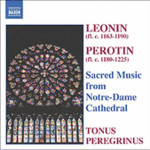 $30.00
Special Order
$30.00
Special Order3 - 6 weeks add to cart
LEONIN / PEROTIN
Sacred Music From Notre-Dame Cathedral
Tonus Peregrinus / Anthony Pitts
[ Naxos / CD ]
Release Date: Monday 20 April 2009
This item is only available to us via Special Order. We should be able to get it to you in 3 - 6 weeks from when you order it.
Léonin, who was considered the master of polyphonic composition in his time and who appears to have been responsible for the magnus liber in its original form, must have spent much of his career in the unfinished 'choir' or Eastern end of the Cathedral
, separated from the regular sounds of construction by some kind of temporary screen which perhaps was moved column by column westwards over the years. By the time Pérotin made a new edition of Léonin's magnus liber and added his own massive polyphonic versions of two Gradual chants, most likely for feast-days in 1198 and 1199, practically the entire space of the Cathedral was ready to resonate in sympathy. Over the next halfcentury and beyond work continued on the building until it was as complete as it ever would be.
Certainly that is the story that seems to be corroborated by the enormous body of music in the magnus liber itself. The foundation of this repertoire is plainchant, unmeasured melodies associated with every liturgical moment in the Church's calendar. Viderunt omnes 2 is a chant for Christmas Day and its octave, the Feast of Circumcision.
There are two very simple ways of constructing polyphony out of plainchant: either by adding a drone, one note held on as a pedal under the plainchant, or by simultaneously singing the same plainchant at a fixed interval above or below (the most obvious example is of men and women, or men and boys singing the same tune an octave apart). The ninth-century treatise Scolica [or Scholia] enchiriadis demonstrates this spontaneous and unwritten practice of parallel organum with a number of examples which we have recorded here as individual verses of a psalm 30.
On top of these early edifices in Western polyphony we can imagine ad hoc experiments in the performance of plainchant in a measured style (with each note either the same length or twice as long as the next), and in the improvisation of a free part over the existing plainchant. Today it is easy to forget how well these tunes, especially those for feast-days such as Christmas or Easter, would have been known by both the professionals in the choir and the congregation in the nave.
Tracks:
Perotin
Beata viscera (monophonic conductus)
Viderunt omnes (plainchant)
Sederunt principes (4-part organum / plainchant)
Vetus abit littera (4 - part conductus)
Leonin
Viderunt omnes (I)
Viderunt omnes (II)
Viderunt omnes (III)
2-part clausula (I): ...Dominus...
2-part clausula (I): ...Dominus...
