
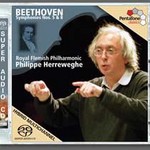
Beethoven: Symphonies Nos. 5 & 8
 $27.00
Out of Stock
$27.00
Out of Stock6+ weeks add to cart
LUDWIG van BEETHOVEN
Beethoven: Symphonies Nos. 5 & 8
Royal Flemish Philharmonic, Philippe Herreweghe
[ Pentatone SACD / Hybrid SACD ]
Release Date: Friday 29 February 2008
This item is currently out of stock. It may take 6 or more weeks to obtain from when you place your order as this is a specialist product.
"This is a delightful and highly entertaining disc containing two fine performances of music that never sounds tired or routine. I look forward to the next instalment with keen anticipation".
FANFARE: Christopher Abbot
"if you're a fan of the RFP and Herreweghe, this disc is a must-have"
Tom Gibbs, Audiophile Audition
"In an extremely crowded field these stand out as fresh and extremely enjoyable readings, made all the more attractive for being available on SACD."
Hugo Shirley, MusicalCritisism.com
Recorded in 2007
Mention the name Beethoven, and the word symphony immediately springs to mind. Justly so, for if there is one standard by which romantic orchestral music is judged, it is the nine-part symphonic oeuvre of this Viennese German. The aesthetic impact can be largely explained by the man's instrumental train of thought. The introduction of his symphonies to the Viennese public at the beginning of the 19th century heralded the birth of a golden age for instrumental music. However, the credit should not just go to Beethoven, according to author, composer and professional dreamer E.T.A. Hoffmann back in 1809: "Nowadays, instrumental music has reached a height that would have been unimaginable not so very long ago. Furthermore, the symphony has become, especially thanks to the schwung bestowed upon it by Haydn and Mozart, the highest category in instrumental music - as it were, 'the opera' of the instruments." Indeed, these gentlemen had experimented quite a bit with the genre, before Beethoven eventually tried his luck. Thus he hardly needed to fiddle with the orchestral scoring, and he remained faithful - with one exception - to the prevalent division of the symphony in four movements.
Nevertheless, it was Beethoven who put the 'opera of the instruments' on the agenda of the Romantic composers. Was that because he expanded the duration of the symphony? Perhaps. Because he attuned the separate movements of the symphony to one another, by means of coordinating total structures? Certainly. However, it was mainly his instrumental eloquence which allowed the symphony to fit in with the musical ideas of the day. To quote Hoffmann once again: "When we talk about music as an independent art, then we can only be referring to instrumental music. This music, which spurns any help from or fusion with another art form, expresses the true essence of art, which is comprehensible only to itself. Instrumental music is the most romantic of all arts - one could almost say, just 'purely' romantic." The supremacy of instrumental music without further content, over illustrative, vocal music: behold, an idée reçue which was to dominate the entire Romantic era. This idea can be found in the philosophical systems of Hegel and Schopenhauer, it turns up in Wagner's theories regarding the theatre, it infects the progressive thinking of Liszt and co., and was rewritten by Hanslick in his scribblings on absolute music. And as a reaction to which music did Hoffmann launch his notorious thoughts? Correct, the music was by Beethoven. It was precisely his symphonic works which emphasized the exclusivity and drama of instrumental music without further content.
Number five in Beethoven's symphonic catalogue is his best and most well-known example of this feature. Thanks to the successful manner in which the composer moulds both form and content to his will, this overwhelming Symphony No.5 (1808) has become an unapproachable status symbol. As far as the technical form is concerned, the Symphony No.5 is a powerful response to the Classical tradition. Thus although the first movement (Allegro con brio) provides the suggestion of a sonata form, this impression is continuously rebutted. By giving free space to the virulent first motif, the second theme is drowned in thematic impetuosity. And the gigantic coda of this movement is anything but conventional: just as in his Symphony No.3, Eroica, Beethoven does not use the coda to conclude the movement, but as a podium on which he is able once again to process the thematic material in an ingenious manner. In contrast, the Andante con moto is a compound of a variations sequence with the sonata form. The ensuing Allegro is not in the least like a dancing scherzo, it is much more a procrastinating preparation for the triumphant finale, which in its turn cannot be pinned down to any classical form analysis.
Of course, such sagacity with regard to technical form remains at the service of the tone of the content, which has made this Symphony No. 5 so unusually popular. In the first place, the expansive phrasing by means of which Beethoven links the various movements: when the ingenious final bars of the scherzo suddenly divert from C minor to C major, and thus launch the resounding finale, it becomes clear that one has arrived at the luminous end of a previously darkly coloured journey. The frankly weird and wonderful effect that Beethoven brings about by means of this auditive journey permits the listener to link all kinds of socio-political, humanitary or philanthropic ideas to the listening experience. But in the separate movements, too, the instrumental drama gives cause for metaphysical listening pleasure. For instance, the short, melancholy oboe solo which suddenly appears in the first movement, the threatening undertones which besiege the second movement, the tentative and disorienting design of the third movement, or the revolutionary intoxication of the finale.
In his Symphony No.8 (1814) too, Beethoven links his (humorous) power of imagination to a sophisticated knowledge of the form. Whereas the Symphony No.5 possesses virile gravity in abundance, this symphony glories in an overdose of appealing charm. Nevertheless, the Symphony No.8 - which, as a rule, is considered to be the "weakling" in the symphonic oeuvre of Beethoven - is no anachronistic faux pas, rather it is an unusually clever reading of the genre. As a result, this musical essay in generosity sacrifices form to musical excess. For the first time in his career, for example, Beethoven presents two corner movements which do without a (slow) intro, and kick off immediately with the main melody. In the opening section, the first and second melodies almost directly switch over to passage work, which - surprisingly - introduces new material. This creates the impression that, unusually, not two but three or perhaps even four thematic groups are challenging one another - and this completely does away with the formal tension of the sonata form. In the finale, too, Beethoven demonstrates his most generous side: in the midst of all the scintillating gusto, the composer introduces a third, contrasting idea (a ceremonious chorale). In the apparently naive Allegretto scherzando, Beethoven adds a special sophistication to the composition, by staging a (for the listener, well-nigh imperceptible) rhythmical stunt, in which the rhythmical pivots are placed at right angles to the prescribed measure. An uproarious climax in this symphony is undoubtedly formed by the third movement (Tempo di menuetto). Instead of the usual scherzo of the day, Beethoven composes a Classical minuet which - if listened to correctly - can be interpreted as a grotesque and nefarious persiflage of eighteenth-century gallantry. The ridiculously exaggerated accents, the naive trumpet motifs, the banal themes, the winds which enter too early at one or two points: these are both subtle and unambiguous hints indicating that the Classical symphony now truly belonged to the past. But also that the future of the symphony was guaranteed in the hands of this composer…
Tracks:
Symphony No.5 in C minor, Op.67
Symphony No.8 in F, Op.93
