
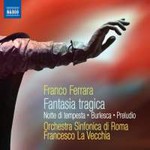
Ferrara: Fantasia tragica / Notte di tempesta / Burlesca / Preludio
 $30.00
Special Order
$30.00
Special Order3 - 6 weeks add to cart
FRANCO FERRARA
Ferrara: Fantasia tragica / Notte di tempesta / Burlesca / Preludio
Orchestra Sinfonica di Roma, Francesco La Vecchia
[ Naxos / CD ]
Release Date: Wednesday 21 September 2011
This item is only available to us via Special Order. We should be able to get it to you in 3 - 6 weeks from when you order it.
The Fantasia tragica is a 'symphonic homage' to Shostakovich, modelled on the third movement ('Eternal Memory') of the Russian composer's 11th Symphony. The youthful Burlesca attests to his high spirited and superbly realised string writing and shares something of a filmic heritage with Notte di tempesta, a late-Romantic score of fulsome accomplishment.
Franco Ferrara's musical gifts were prodigious, although his compositions have been overlooked. Born in Palermo he was a fine pianist, an even better violinist, playing under Toscanini, and later a conductor whose public performances were curtailed by illness, but whose private classes were famous.
"If you haven't heard of Franco Ferrara, you should. A 20th century conductor and composer, Ferrara's sensibility draws on Russians like Shostakovich, while still capturing a dramatic, operatic, Italian feel. His Preludio is initially melancholy and beautifully moody. Textures and shapes emerge from the music, with sweetness in the violins. The music grows loud, but never loses its sense of phrasing and shape, thanks to the Orchestra Sinfonica di Roma under the baton of Francesco La Vecchia. Ferrara's Fantasia tragica is barely audible in the beginning, as it is so quiet, eerie, and tragic as it evolves. The entry of brass is exciting. Very foreboding, it reminds the listener a bit of Sibelius or Shostakovich (Ferrara's source of inspiration). In fact, it might leave the listener with a clear answer of what sort of music one would get if heavy Verdi and Italian drama were crossed with the style of Northern European and Russian composers. The tonally fascinating Notte di tempesta features great colors in the orchestra: high string tremolos, the flute paired with the bass clarinet, and rolling timpani. The menacing passages that move up and down the scale in the low strings are like waves, played with excellent precision by the Orchestra Sinfonica. One is swept away by the waves, the roar, the swells, the thunder. A tightly knit, chorale-like passage is an interesting contrast to the stormy music. The lushness of the strings recalls string orchestra music such as that of Vaughan Williams. The ending is rich, with the strings paired with the warm brass. The last piece on the album, Burlesca, is warm and inviting, very accessible like a film score. One might conjure a Harry Potter film or 1950s films when hearing the music. The beginning is whimsical, with string pizzicato, flute leaps and jumps, and a tinkling triangle. Engaging dialogues between the instruments are complemented by sweeping strings. There is a strong contrast between the warmer passages and a dark, menacing theme, proof that Ferrara knew how to keep dramatic tension in the music. Ferrara should become a household name, especially when played beautifully by the Orchestra Sinfonica di Roma." AllMusic.com
Tracks:
Preludio
Fantasia tragica
Notte di tempesta
Burleska
