
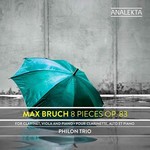
Bruch: Eight Pieces for Clarinet, Viola and Piano, Op. 83
 $35.00
Special Order
$35.00
Special Order3 - 6 weeks add to cart
MAX BRUCH
Bruch: Eight Pieces for Clarinet, Viola and Piano, Op. 83
Philon Trio
[ Analekta / CD ]
Release Date: Friday 20 March 2020
This item is only available to us via Special Order. We should be able to get it to you in 3 - 6 weeks from when you order it.
Max Bruch is most famous for his Violin Concerto No. 1 (1866) and for pieces like Kol Nidrei for cello and orchestra (1880). He also had a long career as a teacher and conductor.
Bruch was 72 in 1910 when he composed Acht Stücke (Eight Pieces), Op. 83 for his son, Max Felix, already a professional clarinetist. A year later, Bruch would pursue these unique sonorities with another work for his son, the Concerto for Clarinet, Viola and Orchestra in E minor, Op. 88. Bruch was certainly aware of the primary works for this formation - Mozart's Kegelstatt-Trio, Schumann's Mârchenerzaülungen (Fairy Tales), and Brahms' Trio Op. 114. The parallel with Brahms is interesting for several reasons: the common stylistic elements, and Brahms' desire to compose again after listening to clarinettist Richard Mühlfeld (to whose playing Bruch's son's was compared). More generally, the clarinet has attracted many composers later in life.
The Eight Pieces shine with Bruch's lyricism. Only Nos. 5 and 6 (among the most well-known) have titles, and, along with No. 3, (Bruch's favourite), these were originally meant to include harp as a fourth instrument. But after discussions with his publisher, Simrock, the harp project was abandoned, and they included alternative violin or cello parts to boost sales. The autograph manuscript has been lost, but an engraver's copy is kept in the Max-Bruch Archive at the University of Cologne, Bruch's natal city.
Each of the eight pieces has its particular charm. Written in a late but conservative Romantic style, far removed from the language of Bruch's contemporaries Stravinsky, Bartók, and Schoenberg, they are much more than short miniatures for the salon. Deep, intense, passionate, and intimate, this music requires talented chamber musicians who understand each other, as is clearly the case here.
© Jean-Marie Paul
