
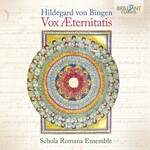
Hildegard Von Bingen: Vox Aeternitatis
 $30.00
Special Order
$30.00
Special Order3 - 6 weeks add to cart
HILDEGARD VON BINGEN
Hildegard Von Bingen: Vox Aeternitatis
Schola Romana Ensemble
[ Brilliant Classics / CD ]
Release Date: Friday 17 October 2025
This item is only available to us via Special Order. We should be able to get it to you in 3 - 6 weeks from when you order it.
The music featured on this CD has a unique origin. Hildegard von Bingen (1098-1179), a mystic, theologian, and German composer, claims to have heard these melodies during supernatural experiences. While other visionaries may lose touch with reality and fall into ecstasy, Hildegard experiences her visions while remaining completely alert. She later conveys what she has seen and heard through imagery, writings, and music. The title of this CD, Vox Aeternitatis, refers to the divine voice that instructs the mystic to write down her revelations.
These compositions are drawn from the Symphonia harmoniae caelestium revelationum, Hildegard's most important musical work. The title reflects the celestial origin of these pieces, which include seventy-seven items such as Psalms, Hymns, Sequences, and Antiphons.
For this performance the artists chose to include musical instruments linked to the environment of medieval monasticism, such as the psaltery, symphonia, cymbals, vielle, percussion, flute, and monochord. Only two voices are featured: one female, ideally representing Hildegard herself, and one male, the monk Volmar, her secretary, responsible for transcribing the content of the visions.
Hildegard's melodies sometimes surpass the compositional conventions of the time, particularly in terms of vocal range and the expansion of melismas - elements that are occasionally pushed to the limits of performability. Her style is remarkably personal and unmistakable, evident in the modal settings that align perfectly with the texts, and in the highly distinctive and recurring melodic formulas that are intimately connected to the spiritual and expressive nature of the lyrics.
Performed with great respect and commitment by Schola Romana Ensemble, founded in 2000 by flautist and conductor Stefano Sabene, a group that specialises in both early and contemporary music. The ensemble presents multidisciplinary musical productions that often engage in dialogue with various art forms, such as theatre, dance, architecture, visual arts, literature, and film. Their commitment to musicological research and experimentation drives the ensemble to explore an extensive repertoire, ranging from the music of ancient Rome to medieval Europe. In this context, they have especially focused on the performance practice of "a cappella" polyphony, rediscovering the so-called "just intonation".
Tracks:
Columba aspexit
Hodie aperuit
Karitas habundat
Laus Trinitate
O eterne Deus
O frondens virga
O pastor animarum
O pulchrae facies
O quam mirabilis
O speculum columbe
O virga mediatrix
O viriditas digiti Dei
O virtus sapientiae
O vis aeternitatis
Spiritus Sanctus vivificans
Vos flores rosarum
