
Shchedrin: Music From the Lady With the Lapdog
 $35.00
Special Order
$35.00
Special Order3 - 6 weeks add to cart
RODION SHCHEDRIN
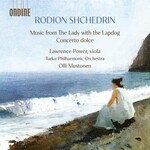
Shchedrin: Music From the Lady With the Lapdog
Lawrence Power (viola), Turku Philharmonic Orchestra, Olli Mustonen (conductor)
[ Ondine / CD ]
Release Date: Friday 20 March 2026
This item is only available to us via Special Order. We should be able to get it to you in 3 - 6 weeks from when you order it.
Composer Rodion Shchedrin (1932-2025) was one of the leading figures of post-war Soviet music. This album by the Turku Philharmonic Orchestra and conductor Olli Mustonen brings together four of his works, including music from his ballet The Lady with the Lapdog, as well as a viola concerto, Concerto dolce, performed by Lawrence Power, one of the greatest violists of our time. Rodion Shchedrin passed away while this album, which is a monument to the unique friendship and artistic collaboration that Olli Mustonen and Rodion Shchedrin cultivated over the course of three decades, was in preparation.
Shchedrin floated freely across styles and combined influences and materials from multiple sources. He described himself with the term 'post-avant-garde' and unlike many modernists was unwilling to anchor himself to strictly defined stylistic parameters. Shchedrin's five ballets (1956-1985) occupy a special place in his output, establishing him as a fully-fledged heir to the Russian ballet tradition (following Tchaikovsky, Stravinsky, Prokofiev, among others) while also determinedly reforming that tradition. The last of Shchedrin's ballets to be completed was The Lady with the Lapdog (1985), written for the 60th birthday of his wife, Maya Plisetskaya. Shortly after, he adapted this 50-minute ballet into a more concise concert piece, titled Music for strings, two oboes, two horns and celesta (1986) - a profoundly intense and emotional piece. It is a summary of the ballet, so to speak, and very closely related to the original ballet in that even the instrumentation is the same.
Shepherd's Pipes of Vologda (1995) was commissioned by the Hungarian Broadcasting Company and is a homage to the Hungarian master composer Béla Bartók. During the early 1950s, as a member of an ethnomusicological research team, Shchedrin travelled to Belarus and Vologda to study and record authentic folk music. Echoes of his encounter with genuine folk tradition can be heard in this work which was completed over 40 years later.
Concertos were an important vehicle for Shchedrin's musical idiom, as is apparent in his catalogue. Although the solo parts in his concertos are always challenging, these are not virtuoso showcases. The concertante aspect is explored through the dynamics of the relationship between soloist and orchestra, between the individual and the collective. Concerto dolce is dominated by soaring viola melodies that often comply with the dolce of the title but also contain intense, painful and edgy tones. The mood of the piece is a tranquil narrative, often intensely meditative or reminiscent, with only occasional departures.
Shchedrin's chamber work The Frescoes of Dionysios (1981) focuses on the sacred: the Orthodox tradition in the Vologda region, above all one of the greatest figures in the Moscow School of icon painting, Dionysios (c. 1440-1502). His most significant and best-preserved set of works is at the Ferapontov Monastery which was designated a UNESCO World Heritage Site in 2000. In this piece, Shchedrin sought to capture the austere, reductive, stylised yet captivating mood of the frescoes.
Tracks:
1-6 Music for Strings, Oboes, Horns and Celesta (Based on the ballet The Lady with the Lapdog) (1986)
7 Shepherd's Pipes of Vologda (Hommage à Bartók) (1995)
8 Concerto dolce (1997) for viola, strings and harp
9 The Frescoes of Dionysios (1981)
