
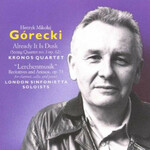
MARBECKS COLLECTABLE: Gorecki - Already It Is Dusk: String Quartet No. 1 / Lerchenmusik: Recitatives and Ariosos
 $25.00
Low Stock
add to cart
$25.00
Low Stock
add to cart
HENRYK GORECKI
MARBECKS COLLECTABLE: Gorecki - Already It Is Dusk: String Quartet No. 1 / Lerchenmusik: Recitatives and Ariosos
Kronos Quartet, London Sinfonietta Soloists
[ Nonesuch Records / CD ]
Release Date: Monday 1 February 2016
This item is only available to us via Special Import.
Henryk Górecki is that rarity among contemporary composers: the originator of a full-fledged hit. A recording of his Symphony No. 3 by the London Sinfonietta with soprano Dawn Upshaw climbed to the top of the British pop charts in the early '90s. Górecki was among the Eastern European composers for whom contemporary stylistic trends (first serialism and then the various reactions against it) took on anti-authoritarian overtones, and who thus emerged in the forefront of late twentieth century music; in his works, stylistic originality seems a personal and political necessity.
Górecki was born in 1933 in the small town of Czernica in the Silesia region of Poland. He was trained as a primary-school teacher, and did not formally become a composer until the age of 22 when he enrolled at the State Higher School of Music in Katowice. He studied in Paris for a time and became acquainted with the leading edge of the Western avant-garde. The works of Webern, Stockhausen, and Messiaen were unavailable in Poland, suppressed by socialist-realist doctrines; but all of them, especially Messiaen, influenced Górecki's early music. Górecki became a professor at Katowice and went on to gain some official acceptance, ascending to the post of provost.
Górecki's music was always deeply rooted in Polish ideals, however, and it carries a sense of the emotional impact of the atrocities of the Second World War. He ran afoul of the authorities in the late '70s, resigning his post as provost to protest the government's refusal to permit Pope John Paul II to visit Katowice. He later composed music to honor an injured Solidarity labor union activist. What gave his protests additional weight was that he had rejected Western hyper-modernism and created a new musical language that more directly served his ideals. Górecki had first gained recognition with Scontri (1959), a work very much of the avant-garde in its treatment of sonority and texture as primary structural elements. In the 1960s, however, Górecki's music offered harbingers of the eclecticism that would dominate contemporary music by the century's end. Genesis shows minimalist qualities, while Three Pieces in the Old Style manipulates modal and whole tone ideas, and Lerchenmusik quotes Beethoven, to name a few examples.
- AMG, All Music Guide
"[the symphony] opens with brutal, relentless chords, disconcerting pauses and Kancheli-like violent dynamic contrasts. There's a degree of relief in gentle passages in intervening movements but the finale's folk-influenced dance-music is expelled by a return of the dark, discordant, forbidding material. Under Andrey Boreyko's sober control the LPO negotiates these contrasts with aplomb." BBC Music Magazine, December 2015 on Symphony No 4
"Górecki's lyricism and faith pervade the piece, but their expression in beautifully-voiced, reiterated melodies is undercut by acrid harmonies suggesting doubt, grief and mental strife. Kronos vividly yet subtly realise and reconcile these inner conflicts." BBC Music Magazine, May 2007 **** (on String Quartets)
"the London Sinfonietta's fine performance, beautifully recorded, is a first choice, crowned by the radiant singing of Dawn Upshaw." Penguin Guide, 2011 edition on Symphony No 3
Tracks:
Lerchenmusik: Recitatives and Ariosos, Op. 53
Already It Is Dusk: String Quartet No. 1, Op. 62
