
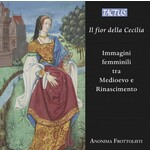
Il fior della Cecilia: Images of Women between the Middle Ages and the Renaissance
 $40.00
Special Order
$40.00
Special Order3 - 6 weeks add to cart
VARIOUS COMPOSERS
Il fior della Cecilia: Images of Women between the Middle Ages and the Renaissance
Anonima Frottolisti
[ Tactus / CD ]
Release Date: Friday 5 June 2026
This item is only available to us via Special Order. We should be able to get it to you in 3 - 6 weeks from when you order it.
The production by the Anonima Frottolisti ensemble, which needs no introduction thanks to its specialisation in the interpretation of medieval and Renaissance music, focuses in this work on the theme of the female figure that has been handed down to us since the fifteenth century. Cecilia represents a life story that is entirely feminine: "The lament and pity, the despair, the condition of women and their redemption," jealousy, the renunciation of nobles and knights for the defence of one's love and dignity, the "Comedy", that is, the theatrical representation of reality. The song has ancient roots in Western music, from the first monodic forms of the 15th century in France, where the protagonist is Pernette, also present in Italy in the Aosta Valley tradition at the end of the 19th century, or in the case of Jeannette, still used in children's stories in French-speaking areas, or in the fifteenth-century example La belle se sied by Guillaume Dufay and the three-voice version by Josquin Desprez, or in the narrative song of the oral tradition of the "three sisters/ladies who come from Lyon," as well as in the sacred sphere, influencing the composition of the Missa la Belle se sied in Ms. 1377 from Trento, or the Missa La Belle se sied composed by Mambriano de Orto and printed by Petrucci in 1505. The disruptive force of this tradition, that is, the traces that branched out from it starting from the European Middle Ages, are still evident and inherent in every musical and literary sphere.
Tracks:
Giovanni Ambrosio:
Rosina
Anonymous:
Danza
Franchoise nouvelle
La Cecilia
La Pastorella
Messa 'La belle se siet'
- Kyrie
Ne pleure pas Janette
Peronette
Poi che'l ciel e la fortuna
Quando lo pomo
Gilles Binchois:
Files a marier
Marchetto Cara:
Non peccando altri che 'l core
Josquin Desprez:
Mon mary m'addifamee
Guillaume Dufay:
La belle se siet au piet de la tour
Luca Marenzio:
La bella Franceschina
Pere Oriola:
Trista che spera
Guglielmo Ebreo da Pesaro:
Belreguardo
Bartolomeo Tromboncino:
Vale diva, vale in pace
